★★★★★
Super helpful!!
“As a new critical care nurse, this is essential to helping me with knowing what doses and rates to expect on my IV pumps when I program them.”
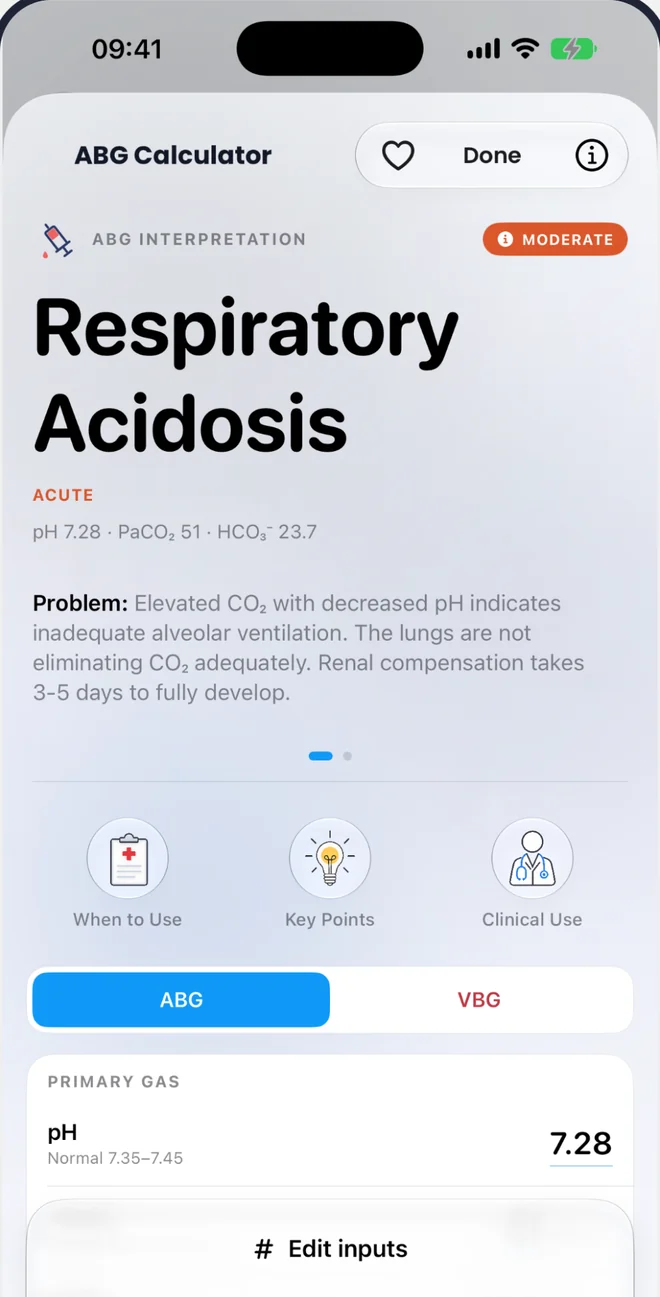
ABG and VBG
Critical Med’s ABG calculator interprets arterial and venous gases step by step. Enter pH, PaCO₂ and HCO₃⁻ and it works out the primary disorder, compensation, anion gap, base excess and Winter’s formula, then explains the reasoning in plain language. It’s an educational reference, not a diagnostic device.
“As a new critical care nurse, this is essential to helping me with knowing what doses and rates to expect on my IV pumps when I program them.”
“It has absolutely everything I could ask for when it comes to work, school, and Clinicals!”
Yes. It has both ABG and VBG modes.
No. It’s an educational reference for clinicians.
Critical Med is an educational study and reference tool. It does not provide diagnosis, treatment directives or emergency services, and it is not a substitute for professional clinical judgment or facility protocols. ACLS study content supports personal exam preparation only; it is not AHA-accredited and does not grant a certification card.